

Refinancing vs. Selling in Indiana & Ohio: Which Makes More Sense in Today's Market?
Should you refinance or sell your home in 2025? We break down the real costs, timelines, and market conditions with actual scenarios from Indiana and Ohio homeowners.

Sarah stares at the mortgage statement in her Muncie kitchen. After five years in their starter home, she and her husband Jake owe $180,000 on a house now worth $240,000. Their current rate? 6.75%.
The question keeps them awake: refinance to something lower, or sell and upgrade to their forever home?
Sound familiar? You're not alone. With 2025 market conditions creating unique opportunities—and challenges—this decision is tougher than ever. Let's break it down with real numbers from actual Indiana and Ohio cases we've handled this year.
The 2025 Reality Check
First, let's get real about where we stand:
- Interest rates: Hovering around 6.5-7.5% for most buyers
- Home values: Still elevated in most Indiana/Ohio markets
- Inventory: Better than 2022-2023, but still tight in desirable areas
- Refinance activity: Down 70% from pandemic peaks
Translation: Neither option is as obvious as it was three years ago.
When Refinancing Makes Sense
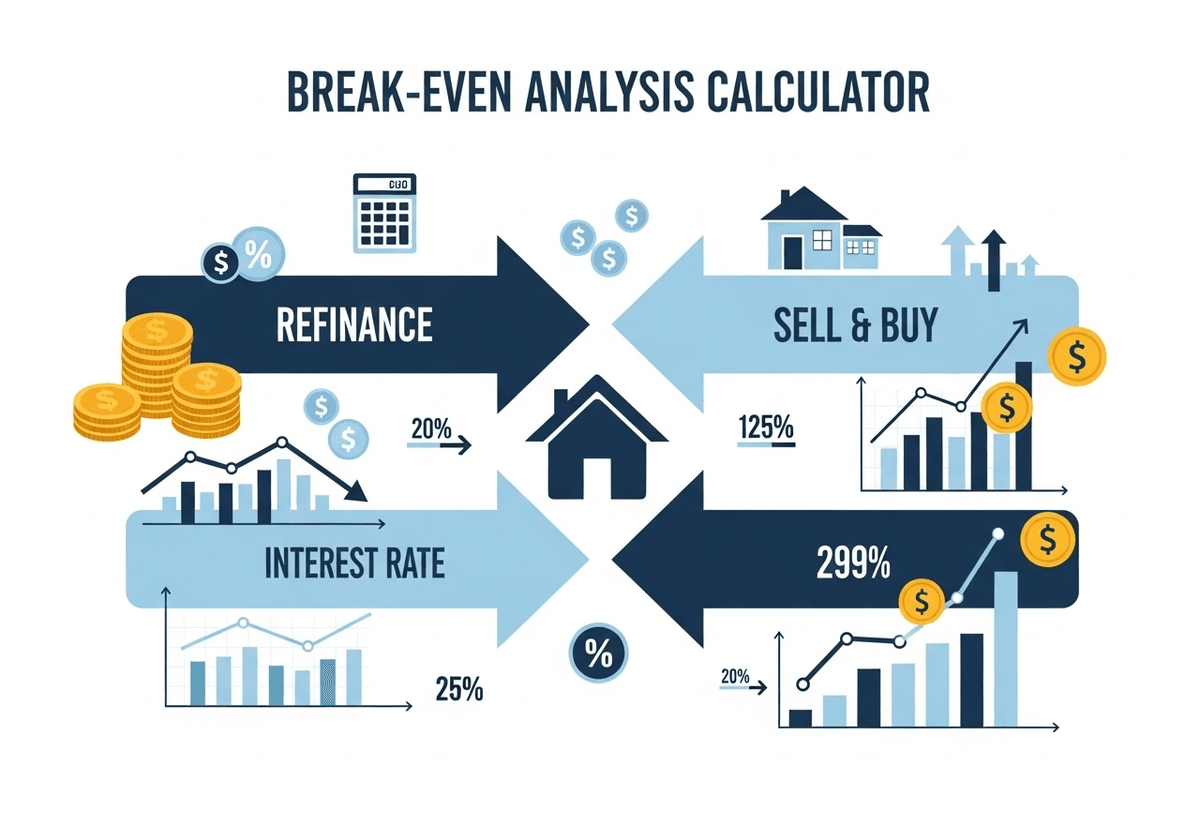
The Golden Rule: You need to save at least 0.75% on your rate to make refinancing worthwhile in today's market.
Here's a real example from our Richmond office:
Client: Mark and Lisa, $220,000 remaining balance, currently paying 7.25%
Refinance rate available: 6.5%
Monthly savings: $112
Refinance costs: $4,400
Break-even point: 39 months
They stayed put. Why? They're planning to upgrade in two years, so they'd never hit the break-even point.
Refinancing Works Best When:
- You're staying in the home for 3+ years
- You can reduce your rate by at least 0.75%
- You want to eliminate PMI (private mortgage insurance)
- You need to switch from ARM to fixed-rate
- You want to tap equity without moving
When Selling Makes More Sense

Sometimes the math says "sell"—even in a challenging market.
Take Jennifer from Dayton. She bought her condo in 2019 for $155,000 at 3.75%. Today it's worth $195,000, but the HOA fees have doubled, and she needs more space for her growing family.
Her choice: refinance the condo and buy a second property (juggling two mortgages), or sell and use the equity for a larger down payment.
She sold. Here's why the numbers worked:
- Net proceeds from sale: $35,000
- 20% down on $275,000 new home: $55,000 (she had savings for the rest)
- New mortgage payment: Only $200 more than her old payment + HOA
- Result: More space, better neighborhood, no HOA headaches
Selling Works Best When:
- You need significantly more (or less) space
- Your neighborhood no longer fits your lifestyle
- Home values in your target area haven't risen as much
- You can use your equity to reduce your new mortgage payment
- Maintenance costs on your current home are becoming burdensome
The Hidden Costs Nobody Talks About
Both options have costs beyond the obvious ones.
Refinancing Hidden Costs:
- Appraisal gap risk: If your home appraises low, your loan-to-value ratio changes
- Rate lock fees: If closing gets delayed
- Prepayment penalties: Some loans have them (rare, but check)
- Lost tax benefits: Restarting mortgage interest deduction calculations
Selling Hidden Costs:
- Inspection repairs: Average $2,500 in our experience
- Staging/prep costs: $1,500-$5,000
- Carrying two mortgages: If your new home closes first
- Moving expenses: Often underestimated at $3,000+
- Rate lock fees on new loan: If construction is involved
Timeline Reality Check
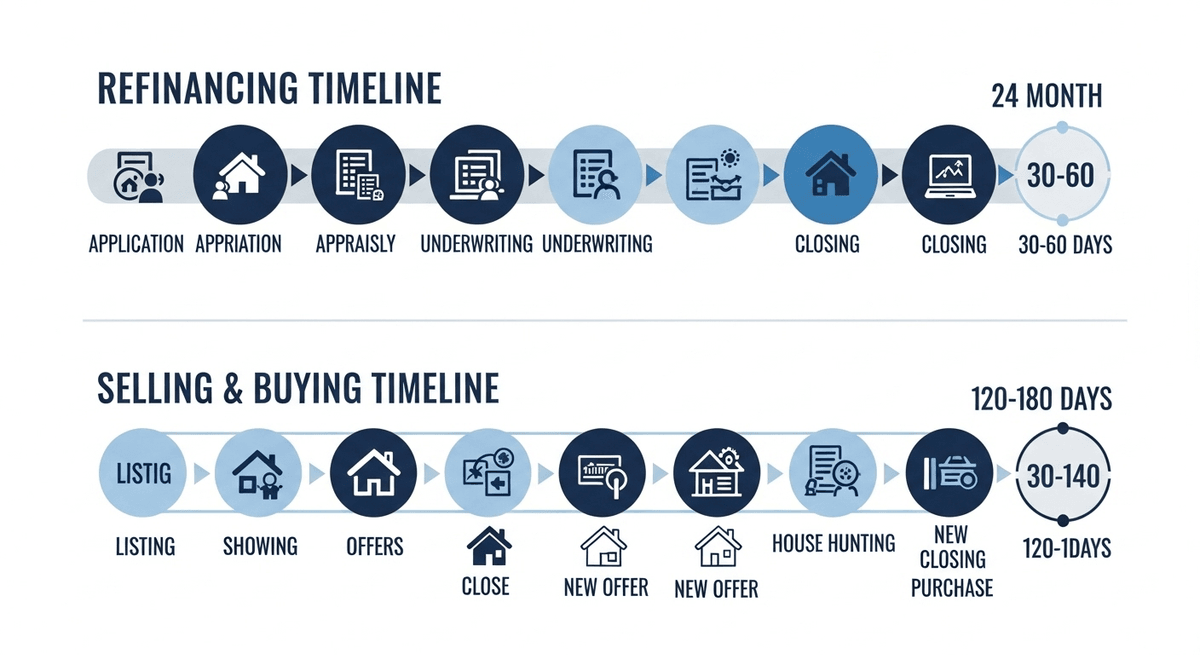
Time is money, and both options require different time investments.
Typical Refinancing Timeline: 30-45 days
• Application to clear to close: 3-4 weeks
• Minimal disruption to daily life
• One set of closing costs
Typical Sell-and-Buy Timeline: 3-6 months
• List and sell current home: 30-60 days
• Find and close on new home: 60-90 days
• Potential overlap or gap period
• Two sets of closing costs
The Market Timing Factor
Here's what we're seeing in Indiana and Ohio markets right now:
Seller-friendly areas: West Lafayette, Dublin (OH), Carmel, Mason (OH)
Buyer-friendly areas: Toledo, Terre Haute, some Cleveland suburbs
Balanced markets: Most of central Indiana, Columbus suburbs
If you're in a seller-friendly market and considering an upgrade, the timing might be ideal. Your home will sell quickly, possibly over asking, while inventory in higher price ranges has improved.
Three Real Scenarios from Our Clients
Scenario 1: The Rate Refugees
Bob and Carol in Fishers locked in at 2.75% in 2021. They want a bigger house but refuse to give up their rate. Their solution? Keep the current house as a rental and buy their forever home. It works because rental demand is strong, and they can afford two payments short-term.
Scenario 2: The Empty Nesters
Jim and Pat in Cincinnati had their four-bedroom house paid off. They sold, bought a condo with cash, and invested the remainder. No mortgage payment, lower maintenance, and a nice investment portfolio to boot.
Scenario 3: The Strategic Refinancers
Mike and Amy in Fort Wayne had PMI and a 7.25% rate. They refinanced to 6.75% and eliminated PMI (home had appreciated enough). Monthly savings: $315. They're putting the savings toward a vacation home down payment.
Making Your Decision: The Empire Framework
After 20+ years helping homeowners navigate these decisions, here's our framework:
Choose Refinancing If:
- You can save 0.75%+ on your rate
- You're staying put for 3+ years
- You love your location and home
- Current home meets your needs
- You want to tap equity without moving
Choose Selling If:
- Your needs have significantly changed
- You're in a strong seller's market
- Your target area hasn't appreciated as much
- Maintenance costs are becoming burdensome
- You can significantly improve your lifestyle
What We're Telling Clients Right Now
The 2025 market isn't kind to fence-sitters. If you're considering either option:
- Get pre-qualified for both scenarios (refinance and new purchase)
- Order a CMA (Comparative Market Analysis) on your current home
- Calculate true break-even points including ALL costs
- Consider your 3-5 year plans, not just immediate needs
- Factor in lifestyle improvements, not just financial ones
Remember: there's no universal right answer. Sarah and Jake from Muncie? They ended up refinancing and using the savings to renovate their kitchen. Total game-changer without the moving stress.
The key is making a decision based on YOUR situation, not what worked for your neighbor or what you read in a national housing blog.
Need Help Deciding?
Every situation is unique. Our experienced team can help you run the numbers and understand your options for both refinancing and selling in today's market.
Market Resources: Calculate Your Closing Costs | 2025 Rate Analysis | Seller Net Sheet Calculator
Get Free Consultation